What Will It Take to Scale Conservation Covenants in Australia?
- Editor
- 6 February 2026
- 9:42 am
- 0 comments
On the essential role that private landholders play in securing Australia’s conservation future
Land Covenantors Victoria recently invited Dr James Fitzsimons, who has spent over 27 years designing and researching the policy and governance settings that underpin effective private land conservation, to talk to members.
A long-time covenantor who stewards land in Central Victoria, Dr Fitzsimons, has held roles with the Victorian Government and (currently) The Nature Conservancy.
Also an adjunct researcher at Deakin University and the University of Tasmania, he brings a rare combination of scholarly rigour and lived experience to his work, which centres on a crucial question: how can conservation covenants be strengthened and scaled to deliver greater conservation impact across Australia?
In the lecture, delivered as part of LCV's quarterly series, Dr Fitzsimons placed covenants within a broader Victorian, national and international context, highlighting both their potential and the role governments must play if privately protected areas are to meaningfully contribute to Australia’s national biodiversity targets.
Here are the highlights:
Australia’s 30x30 target - and the looming gap
Australia has committed to protecting 30% of its lands and fresh waters, and 30% of its oceans by 2030, under the Kunming–Montreal Global Biodiversity Framework.
Currently, around 24% of land is protected - up from just 7% in the mid-1990s. This growth came from:
- State and territory reserve expansion
- The National Reserve System’s targeted land acquisition program (now discontinued)
- The globally recognised Indigenous Protected Area program
- Private land trusts and covenanting programs
However, to reach 30% by 2030, Australia needs to protect an additional 6% of land within five years.
“There’s still a lot of work to do ... private land conservation will be essential if we’re going to get there,” said Dr Fitzsimons.
The role - and growth - of conservation covenants
Conservation covenants form the backbone of Australia’s privately protected area network.
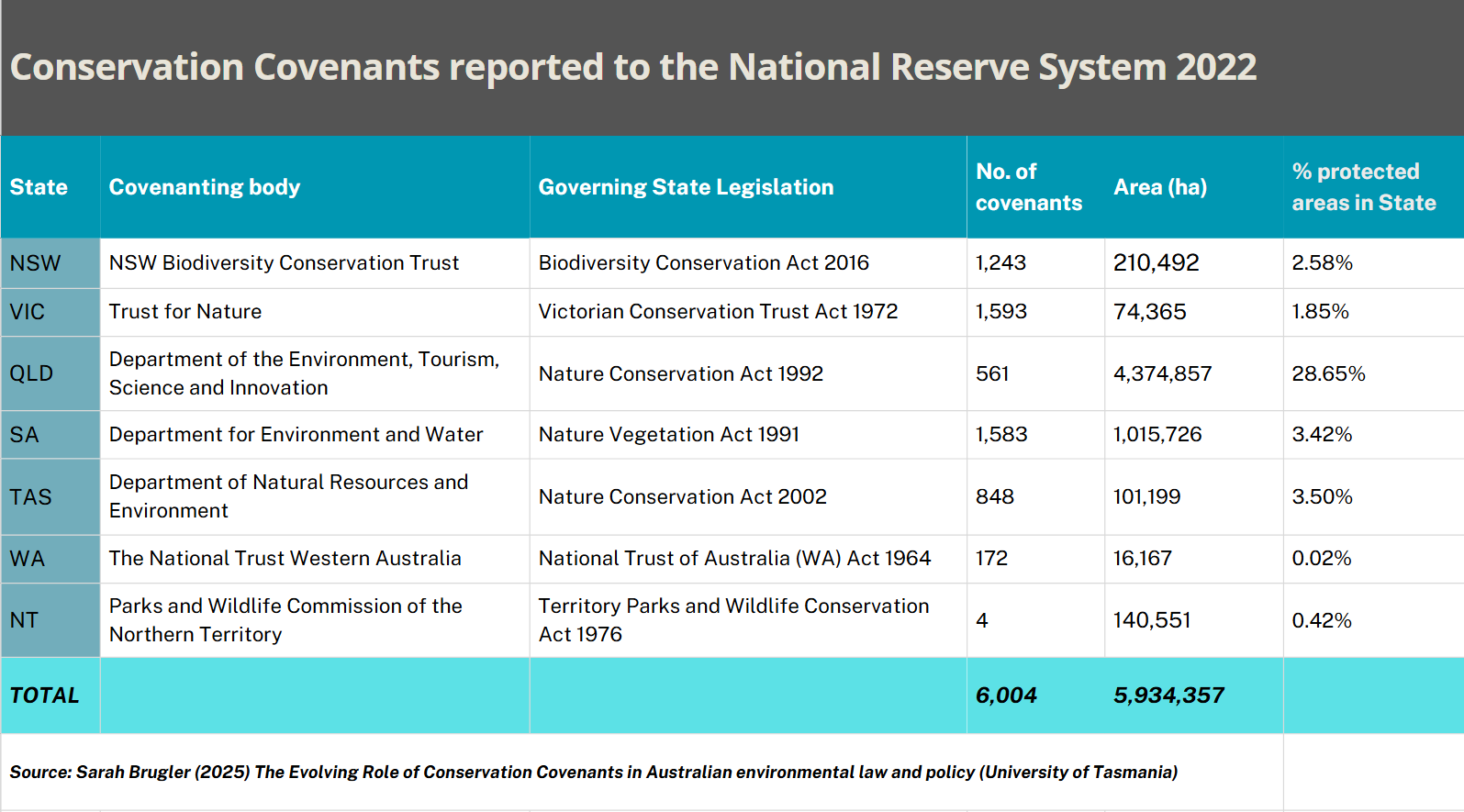
New data presented by Dr Fitzsimons, undertaken by PhD student, Sarah Burgler, shows:
- Victoria has the most covenants numerically
- Queensland has fewer covenants, but a very large area protected
- NSW is the fastest-growing state, thanks in part to a major policy shift
- South Australia has grown slowly since an initial surge in the early 2000s
- Western Australia is growing more slowly than other states
Why NSW is surging
NSW’s growth is strongly linked to a shift from a government-run program to a trust-based model (similar to Trust for Nature) and the introduction of stewardship payments - annual, guaranteed payments attached to covenant obligations. This model has proven especially attractive to farmers who gain:
- A stable income stream
- Predictable financial support in variable climate and market conditions
- Recognition of conservation as part of a working property
Challenges on the horizon: climate change, complexity and competing land uses
Dr Fitzsimons outlined several emerging challenges and opportunities.
1. Covenants must adapt to climate change
Climate impacts - heatwaves, wildfires, sea-level rise - will reshape ecosystems. This raises questions:
- Should covenants include rolling boundaries to allow habitats to shift?
- How can landholders be supported as vegetation quality changes?
- What will climate-resilient covenants look like in practice?
2. The landscape of incentives is growing more complex
Landholders now face multiple programs:
- Carbon markets
- Biodiversity markets
- Nature Repair Market projects
- Land for Wildlife
- Covenants
Choosing the right model - or combination - requires clearer guidance and careful sequencing; in other words, getting the sequencing wrong may preclude eligibility for some of these if others have already been implemented.
3. Second-generation covenantors will have different needs
Many covenants were signed by passionate, first-generation owners. Future owners may:
- Have different motivations
- Have different financial situations
- Require more support to maintain covenant obligations
4. Restoration covenants will become more important
Protecting high-quality remnants is no longer enough. Australia needs large-scale restoration. However, restoration:
- Is more complex
- Requires more oversight
- Requires different policy settings and incentives
5. Land-use competition is intensifying
Renewables, critical minerals, housing and agriculture are all placing pressure on land availability. Strategic planning will be essential.
Bringing the insights together
Key messages:
- Private landholders are essential to Australia’s conservation future.
- They are already caring for vast areas of the country.
- They are motivated by a mix of passion, purpose and stewardship.
- They need supportive, fair and flexible policy settings.
- They play a crucial role in connectivity, refugia, climate adaptation and ecosystem services.
Covenants remain one of the most powerful tools available to secure biodiversity forever. But for covenants to fulfil their potential, Australia needs:
- Better financial and non-financial incentives.
- Strong national recognition of covenantors.
- Simplified and equitable tax and rate frameworks.
- Support for future covenant owners.
- Policies aligned with climate adaptation and restoration needs.
The role of LCV
Land Covenantors Victoria is uniquely positioned to:
- Advocate for equitable incentives.
- Represent covenantors to governments and agencies.
- Share knowledge, science and peer support.
- Strengthen the recognition of covenantors as essential contributors to Australia’s biodiversity goals.
With member leadership and growing research partnerships, LCV is helping shape the next generation of policy and practice for private land conservation.
*LCV holds guest speaker events quarterly in its 'home base' at the Royal Society of Victoria in Melbourne CBD. They are always interested in hearing from conservation and covenanting leaders. Please reach out if you wish to become a member, friend or presenter.
Land Covenantors Victoria acknowledges the Traditional Custodians of country throughout Victoria and their deep connections to land, water and community. We pay our respect to their Elders past and present and extend that respect to all Aboriginal and Torres Strait Islander peoples today.
Contact: info@landcovenantors.org.au
LCV is a Registered Charity. ABN: 28727715232